

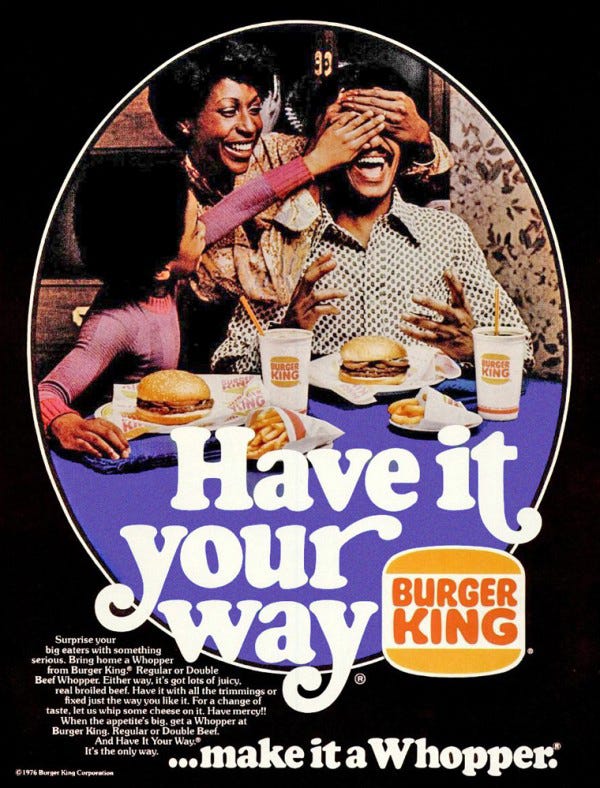
I thought that I was a good father. Then my daughter rocked my world with six words.
“I’ve never been to Burger King.”
As a parent, you strive to have your children experience the things that you enjoyed as a child. As part of my parenting process, I have ensured that my daughter has consistently received a foundational entertainment diet of Looney Tunes, The Muppets, and Star Wars, with dessert provided by some of my favorite ’70s and ’80s sugary pablum. From classics like Smokey and the Bandit, Airplane!, and Flash Gordon to less regarded (by some) fare like Rad, Weekend at Bernie’s, and any Shaw Brothers kung-fu movies featuring the Venom Mob.
Semi-related, a favorite party trick of mine was to have my daughter, in her younger years, perform a spoken-word recitation of the movie trailer for Gymkata. For some reason, as a teenager, she doesn’t like to do this as much now. Big surprise.
Sharing childhood favorites from my actual diet has also been a major tenet of my rearing process. Mostly cheeseburgers, of course. I had deluded myself into thinking that I had been equally successful, until the day my world came crashing down.
During a discussion where I was trying to convince her that in my youth 1) everyone ate at McDonald’s and 2) McDonald’s food was actually good, she blurted out a fact that caused me to question the greatness of my parenting.
She had never been to Burger King.
1981 Whopper advertisement
In my defense, we live in the Golden Age of Cheeseburgers. Shake Shack. Cook Out. The simple but delicious innovation of the smash burger. But facts are facts. She hadn’t been there, and frankly, I couldn’t remember the last time I had visited the Home of the Whopper myself.
And in case you’re wondering, “What does this have to do with Midnight Miami?”, I’ll tell you. The characters of Grits McCoy and Gravy Watkins and the world of Midnight Miami are built upon what I, as a six-year-old in 1981, thought was cool. Race cars. Football players. Motorcycles. Good guys fighting bad guys who were unambiguously evil. And milkshakes and cheeseburgers.
But another reason that Burger King features so prominently in Midnight Miami is a fact that I did not know until I began my research of Miami for the novel.
The Magic City is truly the Home of the Whopper.
Burger King’s story begins in 1953, not as a global empire but as a modest Florida experiment. In Jacksonville, two entrepreneurs opened a small chain called Insta-Burger King, built around a futuristic-sounding Insta-Broiler machine that promised speed, consistency, and modernity. It was very much a product of postwar optimism: fast food as efficiency, technology as comfort, and hamburgers as an expression of progress rather than indulgence.
The company’s real transformation began a year later in Miami, when James McLamore and David Edgerton acquired the struggling operation’s South Florida franchise rights. They saw opportunity where others saw limitation, and by 1959 they had purchased the entire company outright. Miami became the nerve center of Burger King’s rebirth. It was here that the Insta-Broiler was replaced by the flame broiler, a small but crucial innovation that gave Burger King its defining sensory edge. It was also here that the Whopper was introduced—a larger, messier, more confident burger that felt distinctly Floridian in its excess.
Throughout the 1960s and 1970s, as Burger King expanded nationally and internationally, Miami remained its corporate home. The city’s position as a crossroads—between Latin America and the rest of the United States, between old money and new ambition—mirrored the company’s own identity. Burger King wasn’t selling nostalgia. It was selling forward motion. The brand’s advertising leaned into individual choice (“Have It Your Way”), a slogan that fit neatly into a city built on reinvention and second chances.
By 1981, Burger King was no longer just a fast-food chain with a Miami address. It was one of the city’s most visible corporate success stories, employing thousands, hosting executives from around the world, and embedding itself into the daily rhythms of South Florida life. For people working odd hours, chasing deals, or simply killing time in the heat, Burger King wasn’t a destination. It was a constant. And constants matter when you’re trying to make sense of a place.
Last summer, I finally rectified my greatest failing as a parent. I took my daughter to Burger King. We each got a Whopper, fries, and a drink.
And what did we think?
We were both surprisingly impressed. In a word, it was delicious.
While it was not surprising that the burger itself was good (the flame-broiling process does give their patties a fresh-off-the-grill flavor and feel), what really surprised us was the freshness of the toppings. The lettuce, tomatoes, and onions were ripe and juicy. The last burger I had from Burger King’s biggest competitor tasted like it came from a 3-D printer; the Whopper feels like someone made it special just for you.
Burger King endures not because it’s trendy, or artisanal, or particularly interested in impressing anyone. It endures because it understands something fundamental about how people move through cities. Sometimes you don’t want an experience. You want a known quantity. A place where the lights are on, the rules are simple, and nobody asks why you’re there.
That was true in Miami in 1981, and it’s still true now. In a city that was changing faster than anyone could keep up with, Burger King offered a small, dependable pause—five minutes of heat, salt, and certainty before stepping back into the noise. That’s why it belongs in Midnight Miami. Not as a joke. Not as nostalgia. But as part of the infrastructure of everyday life.
And as for my daughter? She’s been back since. Not because she had to. Because sometimes, even in the Golden Age of Cheeseburgers, it’s worth visiting the place that helped build the mythology in the first place.
FOR FURTHER READING, I highly recommend Miami-based food blogger, historian, and writer Sef Gonzalez’s blog Burger Beast, including this great article on the history of Burger King.