

When most people think of Miami in the 1980s, they are usually thinking about a version of the city that did not fully exist yet.
They’re thinking about Miami Vice.
Flamingos. Ferraris. Hot pink and pastel blue. Black t-shirts under white sport coats. Loafers without socks. Jan Hammer’s synthesizer telling you something dramatic is about to happen.
But when I chose Miami as the location for the first Grits & Gravy Mystery (Midnight Miami, coming May 12, 2026), I was not interested in that Miami.
I wanted the city that existed before the myth became profitable.
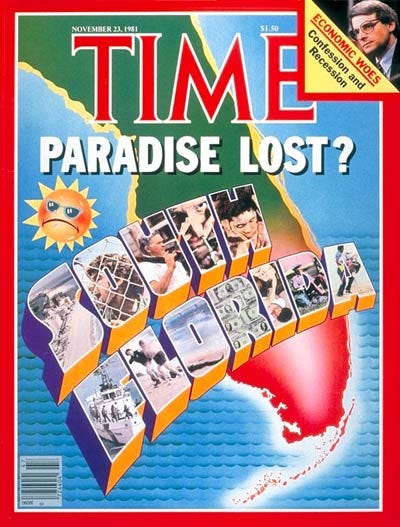
The Miami of 1981. The year Time Magazine called the city “Paradise Lost.” A year with 621 murders, nearly double the total from two years earlier. A year when the Medical Examiner had to rent a refrigerated truck to handle overflow.
And somehow, despite all of that, the city did not collapse. It adapted. It survived. It reinvented itself.
To me, the real story of 1981 Miami starts before the 1980s.
It starts in 1979, with the Dadeland Massacre.
On July 11, 1979, two heavily armed gunmen entered the Dadeland Mall liquor store in broad daylight and opened fire on rival drug traffickers inside. The attackers used shotguns and automatic weapons in a crowded suburban shopping center during normal business hours. Two people were killed and two were wounded. What shocked investigators was not only the violence, but the brazenness. This was not a back alley execution. This was organized, public, and meant to send a message.
The Dadeland Massacre marked a turning point for Miami law enforcement and public perception. It showed that international drug trafficking organizations were willing to conduct open warfare on American soil. It forced local and federal agencies to recognize that Miami was no longer just a transit point for drugs. It had become a battlefield. The event is widely viewed by historians and law enforcement as the moment the cocaine cowboy era truly began.
After Dadeland, the reign of cocaine cowboys had begun.
By 1981, Miami had become the primary entry point for cocaine entering the United States from Colombia. Smuggling networks operated through speedboats, private aircraft, cargo shipments, and complex money laundering systems. Colombian cartels established distribution hubs across South Florida, working with local criminal organizations to move product inland. The sheer volume of money entering the city overwhelmed existing financial and law enforcement systems.
Violence escalated accordingly. Contract killings, car bombings, and public shootings became disturbingly common. In 1979, Colombian trafficker Alfredo Duran was murdered in Miami in what investigators tied to cartel disputes. In the early 1980s, drug-related assassinations were frequently carried out in parking lots, restaurants, and residential neighborhoods. One particularly notorious tactic involved motorcycle drive-by shootings using automatic weapons. These attacks were meant not just to eliminate targets but to intimidate entire networks.
And if this was not enough, Fidel Castro contributed to the chaos.
In April 1980, following internal tensions and diplomatic pressure, Cuban leader Fidel Castro announced that anyone who wanted to leave Cuba could depart from the port of Mariel. Over the next six months, approximately 125,000 Cubans arrived in South Florida. Many were families seeking opportunity and freedom from economic hardship and political repression. The scale and speed of the migration overwhelmed federal and local infrastructure.
However, Castro also used the opportunity to release individuals from prisons and psychiatric institutions. U.S. authorities later confirmed that among legitimate refugees were individuals with criminal histories and serious mental health conditions. This complicated resettlement efforts and fueled public fear and political tension throughout South Florida.
The sudden population increase placed immediate pressure on housing, employment, and social services. While the vast majority of Mariel refugees were law-abiding and hardworking, law enforcement agencies did document increases in certain categories of crime tied to individuals with prior criminal histories. Combined with escalating drug violence, the result was a perception in 1981 that Miami was spiraling out of control.
So how did the Miami of 1981 not only weather this storm, but move to even greater heights? The answer surprisingly starts with cocaine.
Illicit drug money flowed into Miami’s financial system at unprecedented levels during the late 1970s and early 1980s. Investigations later revealed that billions of dollars were laundered through local banks, real estate purchases, and shell corporations. While illegal and corrosive in the long term, the immediate effect was massive liquidity. Construction boomed. Luxury goods sales exploded. Banks posted record deposits. Some South Florida financial institutions grew dramatically due to capital inflows regulators struggled to trace or control.
Miami eventually began to recover through a combination of aggressive law enforcement, federal prosecutions, banking reforms, and economic diversification. Specialized drug enforcement task forces, expanded federal RICO prosecutions, and stronger international cooperation gradually weakened cartel operations inside the city. By the late 1980s and early 1990s, Miami was transitioning from a crime headline to a global financial and cultural hub.
At the same time, Miami diversified its economy into tourism, international banking, trade with Latin America, and real estate development. The city leveraged its geographic position and cultural diversity to become a gateway between North and South America. Crime did not disappear, but the city learned how to survive alongside global attention and economic transformation.
In the end, a city is only as good as the people that make it up.
In the late 1970s and early 1980s, the Miami Design Preservation League, led by Barbara Baer Capitman, played a crucial role in saving the historic Art Deco architecture of South Beach. At the time, many buildings were deteriorating and slated for demolition. Capitman and her colleagues pushed for historic preservation status, public awareness campaigns, and zoning protections. Their work preserved what would later become one of the most recognizable architectural districts in the world and laid the foundation for South Beach’s cultural and tourism renaissance.
The Cuban community also played a major role in Miami’s post-1981 recovery and growth. Cuban entrepreneurs built businesses across industries ranging from banking to hospitality to media. Institutions like Calle Ocho’s commercial corridor and the expansion of Spanish language broadcasting helped establish Miami as a hemispheric cultural capital. Cuban American political leaders and business owners helped stabilize neighborhoods, build economic networks, and strengthen Miami’s identity as an international city.
In 1981, South Beach real estate was relatively inexpensive and often declining in value. Many Art Deco buildings were aging, undermaintained, and viewed as relics rather than assets. As one concrete example: a major Ocean Drive property later associated with the district’s revival (then operating as the apartment-house Amsterdam Palace) was purchased in 1980 for $600,000. Today the former Amsterdam Palace (now the Villa Casa Casuarina) is commonly estimated in the tens of millions, with online valuation models ranging from roughly $37 million to $87 million. In 2025, South Beach real estate ranks among the most expensive in the Unite
Miami in 1981 was not glamorous. It was volatile. Complicated. Frequently frightening. But it was also resilient in a way that is difficult to explain unless you lived inside it.
The city absorbed waves of migration, global crime pressure, economic shocks, and cultural change, often at the same time. And somehow it kept moving forward, sometimes by design, sometimes by accident, sometimes because there was simply no other choice.
The neon version of Miami that most people remember did not appear out of nowhere. It was built on top of a city that had already survived more than most American cities ever experience.
That is the Miami that interested me when I wrote Midnight Miami. Not the postcard. Not the television version. The place that existed when the future still felt uncertain and everyone was improvising.
And if you want to understand how a city becomes a legend, you start by looking at the years when it almost wasn’t one.
FOR FURTHER READING, I highly recommend The Year of Dangerous Days: Riots, Refugees, and Cocaine in Miami 1980 by Nicholas Griffin for a better understanding of pre-Miami Vice South Florida.