

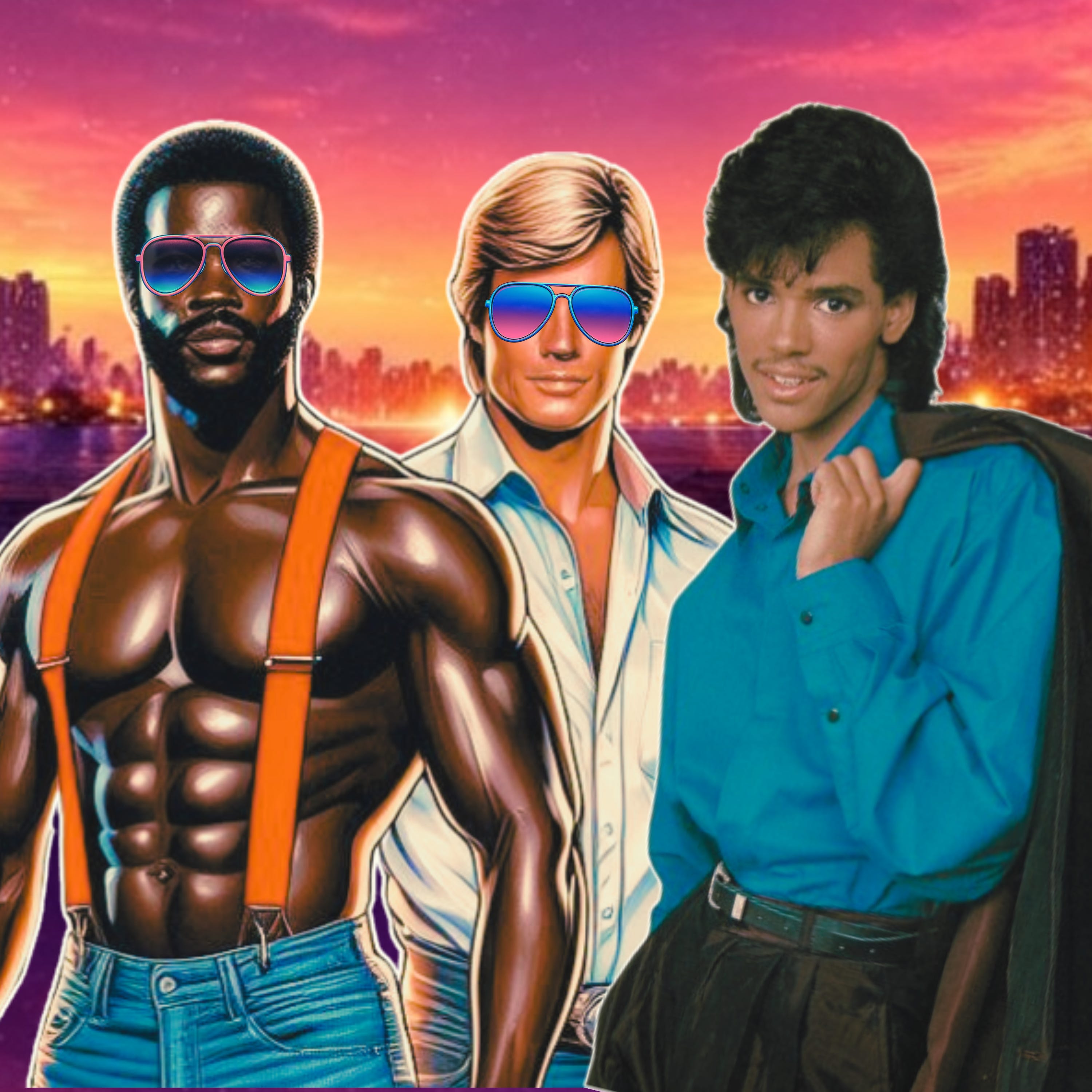
Midnight Miami, the first novel in the Grits & Gravy Mystery series, started as a very specific concept.
The book was meant to be a novelization of a very influential—and most importantly, nonexistent—1982 action movie.
In early drafts, I took that idea a step further by writing an Author’s Introduction that provided a backstory not only for the movie and book, but for me as the writer of the fake movie and subsequent novelization.
Interesting idea? Maybe.
Extremely confusing and convoluted, especially for a first-time author? Absolutely.
While this section didn’t make the final cut, it does offer a look into how the world of Grits and Gravy came together—and, at the very least, it explains the DeBarge jokes in the book.
What follows is that original “lost” introduction, written from the perspective of a man who insists the fake movie was real.
I hope you enjoy. —SMC
Author’s Introduction
Right now, you are holding in your hand a book that I thought had been lost forever.
It is my novelization of the 1982 film Midnight Miami, a highly influential but barely seen action-comedy-horror movie that introduced the supernatural detective team of Grits McCoy and Gravy Watkins to American audiences.
A movie that I conceived and wrote.
A movie that was my dream come true.
And a movie that might truly be lost forever.
Some quick background on how we got here.
The story begins with a hastily filmed 1979 low budget Italian action film simply titled Grits & Gravy. The movie starred Isaiah Jefferson Lincoln as Ernest “Gravy” Watkins, cocky ex-football player who loves roller disco, and actor-singer Shaun Frampton as Francis “Grits” McCoy, cocky ex-race car driver and the best friend of Gravy Watkins. The duo battle Count Dracula, played by an unrecognizable Tomas Milian, to save their favorite roller disco. This film was never released in the United States.
The movie was directed and produced by Umberto Ruggero, an Italian director best known for making giallo movies that prominently and frequently displayed the nude body of his wife, Italian actress Sophia Amaretto, including such “classics” as The Killer Is in the Shower with You, Vampire Lust, and Shower of the Cannibals.
And if you could not guess, the original Grits & Gravy was written by yours truly.
I had moved to Italy in the early 1970’s as an idealist. I was a young, long-haired film school graduate from Montana State University with dreams of becoming the next Federico Fellini. Within a few years, after realizing the importance of having food to eat and therefore the value of a steady paycheck, I found myself as a part of Umberto Ruggero’s regular writing crew. Instead of writing the next 8 1⁄2, I was crafting scripts with critical plot points fashioned to justify Sophia Amaretto’s third shower within the same movie.
Fortunately for me, in 1979, Ruggero was looking for a reason to do something outside of the giallo/horror genre, and he saw the opportunity to exploit the roller disco craze of the time. Ruggero gave me two weeks to come up with a script. The first time that my vision would be on the screen.
The story was straight forward. Grits and Gravy are retired athletes and best friends who spend all of their time at a roller disco in Hollywood, California that the vampire Count Dracula decides he wants for himself. Conflict ensues. Roller disco dances, too. Showers are taken. Grits and Gravy eventually triumph and kill Dracula. Citizen Kane, it was not; however, I wrote a script that was now going to be a real movie.
At the time of production, Shaun Frampton was an American actor trying to make it any way he could. He was born as Milton Schneider in 1955 in Tiffin, Ohio. His agent gave him his stage name based on his vague resemblance to rock superstar Peter Frampton. While Shaun was trying to get his footing in Hollywood, he recorded a novelty song, “(Oh, Yeah) I Love My Disco Girl (Dance).” The song, as even the singer himself freely admits, was terrible. The tune mercifully escaped notice in the states but caught on in Italy, where one of Ruggero’s mistresses noticed him during an appearance on an Italian music show in 1978. Frampton was cast shortly thereafter as Grits McCoy.
By 1979, Isaiah Jefferson Lincoln was already a well-established star in Italian movies. Born in 1948 in Folkston, Georgia, Isaiah was a successful college football player, setting various rushing records for Jacksonville A&M University, but a knee injury in his senior year ended his professional career before it began. Instead of sulking, he took up weightlifting and quickly became a popular draw on the competitive bodybuilding circuit. The combination of his tremendous physique and magnetic personality drew the attention of Italian producer Dino De Laurentiis, who was looking for a new face to cast as the star of his next film.
Lincoln’s first movie, 1973’s Black Hercules, was a massive hit in Italy, but he quickly became a victim of his own success. Isaiah Jefferson Lincoln found himself starring in movies which were blatant rip-offs of popular American flicks, but with the word “Black” affixed to the title. A few highlights for Isaiah Jefferson Lincoln from this era include Black Logan’s Run, Young Black Frankenstein, A Clockwork Black, and Black Herbie Rides Again. My personal favorite of his films broke the tradition of adding “Black” to the title but kept the spirit: Fernando Di Leo’s reinterpretation of Harold and Maude entitled 1974’s Jackson and Maude.
Lincoln was getting steady work, but his career had plateaued at the time of Grits & Gravy. I wrote the character of Gravy Watkins with him in mind. When the offer for the role was extended to him, he gladly and eagerly accepted.
The 1979 movie was nothing exceptional, but Shaun Frampton and Isaiah Jefferson Lincoln as the vampire fighting best friends had a unique chemistry that was plain to see. You enjoyed them together on the screen. In addition, both actors were great action performers. You believed that they could kick a vampire’s ass in a fight, even while wearing roller skates.
But most importantly, the movie made money in the European markets.
To be honest, the film probably achieved financial success due to several completely unnecessary nude scenes featuring Sophia Amaretto, including one memorable scene with Amaretto and fellow giallo mainstay Barbara Bouchet, in which the women take a shower together, while keeping their roller skates on. (By the way, I did not write those scenes. All the credit goes to Ruggero).
Regardless, I was the writer of a successful, profitable movie, and that same movie established Shaun Frampton and Isaiah Jefferson Lincoln as a marketable duo as action stars. And it began a journey that would take all three of us back to the United States.
After wrapping the movie, I could not stop thinking about the characters of Grits McCoy and Gravy Watkins. In my spare time, I found myself writing scenarios for them and fleshing out their backgrounds. I was creating a universe that revolved around them. I had uncovered something very special with Grits and Gravy, but there was a missing ingredient that I had yet to find.
In late 1980, during a location scouting trip for an upcoming Umberto Ruggero production, I found that ingredient. The Magic City. Miami, Florida.
Miami in 1980 captivated me in a way that that no other place had since I first arrived in Rome. The explosion of violence with the drug trade and the chaos resulting from the Mariel Boatlift created a strange, permeating dark energy that was contrasted by the beauty of the city and the constant South Florida sunshine. The darkness, the light, and those who live in the shadows between both worlds. The perfect location for Grits McCoy and Gravy Watkins.
With my idea now fully formed, I first brought my proposal to Umberto Ruggero. Despite the profitability of the first film, Ruggero could only see the characters in the light of the roller-disco fad, which was quickly burning out. He was also back in the giallo headspace. The movie that brought us to Miami was eventually released as Cannibal Mermaid of Atlantis, which allowed Sophia Amaretto as the titular (no pun intended) mermaid to stay in the shower for most of the movie. In the end, Umberto graciously gave me the blessing to take the concept elsewhere to get it made, in addition to putting me in contact with American producers, including a new production company headquartered in Miami.
When Ruggero and crew returned to Italy, I remained behind in Miami and worked with this new company, which will remain unnamed for reasons to be made clear shortly. What made this company different was their focus on incorporating what they called “brand integration” into the films they were making. Not just good old product placement like having Richard Dreyfuss drink a Budweiser with the bottle’s label in plain view, but to have companies and their products become an integral part of the movies itself.
In reviewing the roster of their clients, two companies stood out to me, as one was coincidentally already featured prominently in the script, and the second could easily be slotted into it. Negotiations began. The fact that we had established characters with a track record of success (even if it was in Europe) worked well in our favor. Shortly thereafter, Midnight Miami entered pre-production with Burger King and Motown Records onboard as corporate supporters.
A large factor in Burger King’s backing and enthusiasm for the project was due to the location of the story. When I originally wrote the screenplay, I was unaware that Miami was the headquarters of Burger King International. The support of The Crown was unwavering during our production, including allowing us to shoot on location at various franchise locations within Miami.
Motown Records intended to use Midnight Miami to promote a new album by one of their hottest artists. Funk-rock superstar Petey Maymoore was a perfect choice to provide the soundtrack to the world of Grits and Gravy. A selection of songs from his 1981 hit album Heat in the Sheets were featured in the movie.
The second Motown artist proved to be a little more difficult to fit into our movie. DeBarge was a family group that released their first album, The DeBarges, with Berry Gordy’s label in 1981. To be frank, the album wasn’t their best work, and I had a hard time finding a place for them in the story. As I got to learn more about the group, I became more intrigued by the names of the DeBarge family members (including El, Bunny, and Chico) than their music.
In the end, their presence in Midnight Miami was mostly via speculation on the names of other DeBarge family members. Berry Gordy did not find these jokes as funny as I did. While the movie remained DeBarge-free, you can find the DeBarges appearing throughout the novelization.
And before you feel too bad for them, DeBarge eventually got silver screen exposure in 1985’s The Last Dragon, which prominently featured their hit “The Rhythm of the Night” in the film.
(Note: An agreement with the C.F Sauer Company fell apart right before production. While the references to Duke’s Mayonnaise did not make it into the movie, they remained in the novelization).
The hippie idealist who arrived in Italy with no money in his pocket had sold out to the man in less than ten years. And in a few months, that decision would become a regret that haunts me to this day.
With the wind of Burger King and Motown at our backs, things began to move quickly. My deal gave me the role of Executive Producer with final say on casting and script. My first job was to get Shaun Frampton and Isaiah Jefferson Lincoln to reprise their roles, as I could not see anyone else playing those characters.
Shaun Frampton was the first to sign on. He was already back in the United States as an actor on Days of Our Lives, playing the dual role of Dr. Abraham Horton, a brain surgeon who is also a rock singer, and Dr. Spruce’s separated-at-birth twin brother, Gemini, who is an acrobat in an evil traveling circus.
For a while, I was worried about getting Isaiah Jefferson Lincoln back in the role of Gravy Watkins. At the time, he was still in Italy and getting ready to start shooting another movie. Fortunately, the production of Black Kramer vs. Black Kramer was pushed out for six months, and Isaiah Jefferson Lincoln was soon on location in Miami to begin filming.
Full casting was completed shortly thereafter. Production for the movie was scheduled for seven weeks from September to October 1981. Filming was completed on schedule. To date, Midnight Miami was the smoothest production on which I have ever worked.
As the film went into post-production, when I was not watching the progress in the editing room, I spent my time working on the novelization of the script. As I look back on that time, the months that I spent creating the novelization was one of the most rewarding experiences of my life. I was able to provide more depth to the main characters in the movie, and to give more life to peripheral characters who had been consolidated during the filming process or edited out completely (e.g. Tom Torpedo). Even though the movie would be the money maker, I enjoyed the opportunity to create the world of Grits and Gravy exactly as I envisioned it.
As the new year arrived, buzz about the film began to build in the trades. A bidding war was brewing. Expectations climbed even higher when a week of exclusive screenings for industry executives was scheduled to begin on March 15, 1982. I thought that choosing the Ides of March as the first screening date was funny at the time, but I didn’t shortly thereafter.
March 15, 1982, was the best day of my life. In addition to being the night that the completed picture was first shown to a live audience, that was also the day that I sent my final manuscript for the novelization to the publisher. At that first screening, I have never seen a crowd react to a movie like they did that night. They laughed when they were supposed to laugh, gasped when they were supposed to gasp, and cheered when they were supposed to cheer. When the movie ended, they stood and applauded.
That night, we toasted and cheered our success. The offers would start rolling in, and our problem would be on which one to choose. I distinctly remember thinking that everything to this moment had gone just too well. I was waiting for the other shoe to drop.
And it dropped shortly thereafter, on March 24, 1982, when the FBI raided the production company’s headquarters in Miami.
In short, the production company behind Midnight Miami was actively laundering money for a variety of nefarious organizations, including the Medellín Cartel, the Palestine Liberation Organization (PLO), and Greenpeace. They were innovators in more ways that just brand integration.
The fallout was swift. Agents from every Federal agency began scouring and confiscating anything related to the company and accordingly the movie, including old drafts of my scripts and novelization. Burger King and Motown sent their lawyers into action, doing everything that they could to scrub their client’s names from this debacle. The movie and its assets seemed to disappear down the memory hole.
I spent the next two years in meetings with lawyers and agents from every law enforcement entity that you can imagine. By the time it was all over, I was penniless and wanted nothing to do with showbiz.
The good thing about being at the bottom is that you have nowhere to go but up. In 1985, I moved to Richmond, Virginia. I got my license to sell Property and Casualty insurance, joined a church, found a wife, had three kids, and put my career in movies behind me.
Fortunately, I used a nom de plume for all of my work, beginning with my stint with Umberto Ruggero, which allowed me to totally put my past behind me, especially in the pre-internet age. I am still using it here, so don’t waste your time trying to find me, even if you need an auto insurance quote.
Even though I was out of the movie game, I still missed Grits McCoy and Gravy Watkins. I would find myself occasionally scouring the internet to see if anything would turn up. And eventually, something did.
In 2024, I found an eBay listing advertising a box of paperback 1980’s film novelizations. Amongst the titles that you would expect (Raiders of the Lost Ark, Goonies, Ghostbusters, Back to the Future), I saw words that I never expected to see again.
Midnight Miami.
Within a week, the book was in my hand. I was looking at the cover, a replication of the movie poster that I had not seen since the screenings in 1982.
At first, I was torn. Did I even want to revisit this time in my life? Would I be embarrassed at what I wrote?
Then I opened the book and read it cover to cover.
What did I think of it?
Well, you’re here today with it in your hand. If it was that bad, I wouldn’t have found an attorney to help me reclaim my intellectual property and ensure that it received proper publishing.
Without spoiling anything about what you are about to read, I think that the book does a great job of capturing the true zeitgeist of Miami right before Scarface and Miami Vice defined it for 1980s viewers. And that maybe, just maybe, Grits McCoy and Gravy Watkins had a little influence.
And speaking of 1983’s Scarface, I would like to remind readers that Midnight Miami was ready for release in 1982. I didn’t forget that I started this introduction by calling my baby “highly influential.”
First, Midnight Miami features and refers to various real locations in Miami, including the Mutiny at Sailboat Bay. In the film and novelization, several critical scenes take place at the Mutiny, and the nightclub is directly referred to by name. In Scarface, the Mutiny is there in spirit, but instead is represented by the fictionalized Babylon Club. (For more on the Mutiny and Miami during this time in the 1980s, I highly recommend Hotel Scarface by Roben Farzad).
Second, all I’m going to say is that Oliver Stone and Brian DePalma might owe me a drink for one particular line that was used first in Midnight Miami.
At the beginning of this introduction, I also said that the actual film of Midnight Miami “might truly be lost forever.” As of today, that is true. But the day before I found that eBay listing in 2024, I would have told you that the novelization was lost forever, too. So, you just never know.
Lastly, and most importantly, I have enjoyed the opportunity to reacquaint myself with my old friends, Francis “Grits” McCoy and Ernest “Gravy” Watkins. Unlike me, they haven’t aged a day. No thinning hair or crow’s feet or unintentional grunts when they get in or out of a chair. They are preserved at their prime.
And I hope that you enjoy getting to know them too.
S. M. Chase
Richmond, Virginia
June 2025
About the Real Author
S. M. Chase is the author of Midnight Miami, a neon-soaked supernatural detective novel set in 1981 Miami.
Midnight Miami, available for pre-order at Amazon and Barnes & Noble, arrives May 12, 2026.