

One of my favorite parts of writing Midnight Miami was time traveling back to South Florida in 1981. Because the novel is an urban fantasy mystery, I felt a particular obligation to get the “urban” part right.
If you are going to ask readers to believe in werewolves and paranormal detectives, the streets need to feel authentic.
Some locations were easy to research. Roben Farzad’s Hotel Scarface provided extraordinary detail about the Mutiny at Sailboat Bay, the hotel and nightclub that helped inspire the Babylon Club in the 1983 film Scarface. Other places required more effort: newspaper archives, property records, interviews, and city directories that sometimes contradicted one another.
Here are a few real places that appear in Midnight Miami, arriving May 12, 2026.
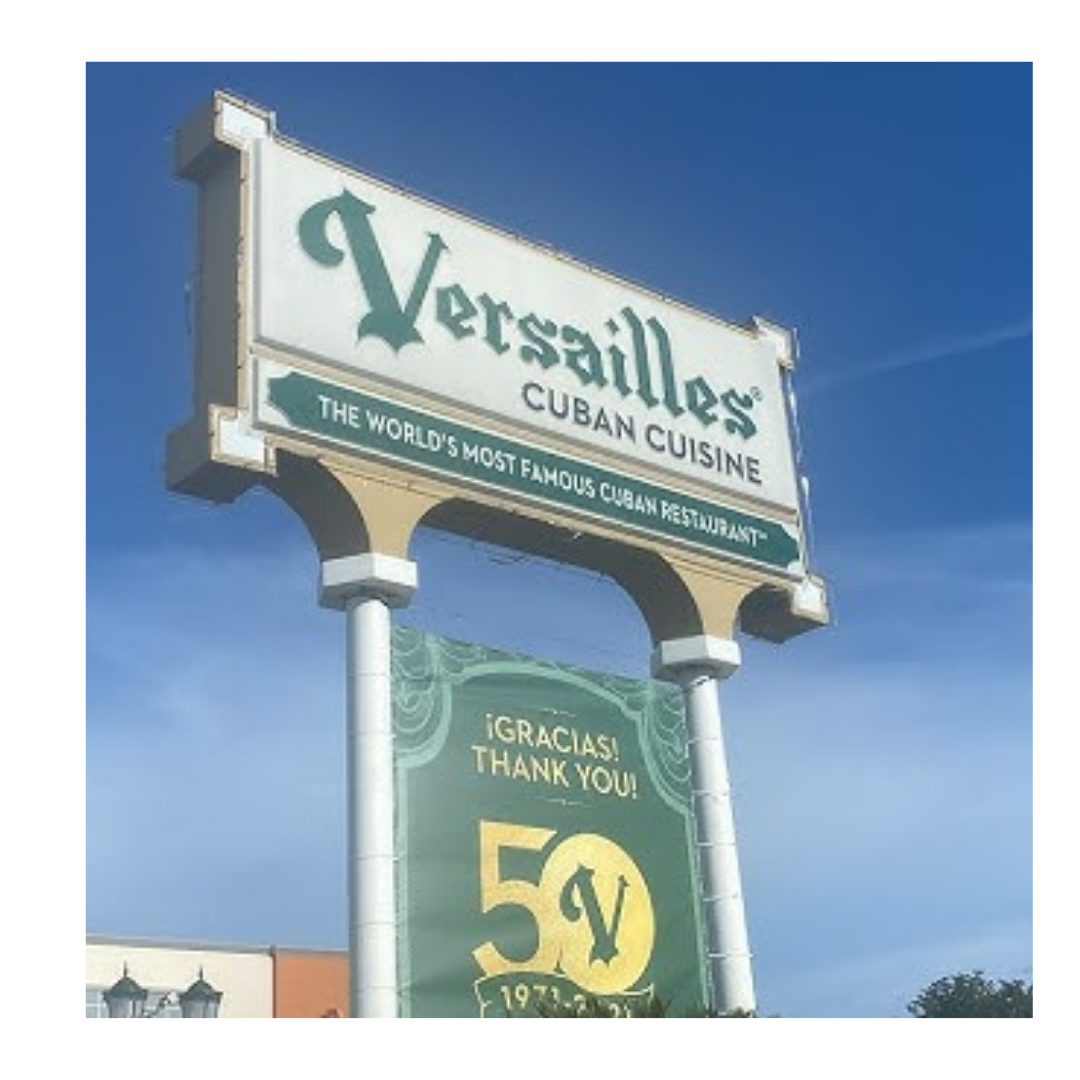
Versailles Restaurant, 3555 SW 8th St, Calle Ocho
When I needed a location within Little Havana, the choice quickly became obvious.
“The world’s most famous Cuban restaurant.”
Versailles was founded by Felipe Valls Sr., who fled Cuba in 1960 after Fidel Castro’s Communist revolution. Like many exiles of that first wave, Valls arrived in the United States with little but determination and a refusal to accept what had happened to his homeland. The restaurant he built was not just a business venture. It was an act of defiance.
Opened in 1971, Versailles became more than a restaurant almost immediately. It became a gathering place for Miami’s Cuban exile community. The Cuban community that formed in Miami during the 1960s and 1970s was intensely anti-Communist, shaped by confiscated property, political imprisonment, and forced exile. Versailles became one of the most visible symbols of that spirit. If Havana had been taken, Calle Ocho would not be surrendered.
Inside, it functions as both cafeteria and institution. Generations at the same table, conversations shifting easily between politics, baseball, and business fueled by great Cuban food
Versailles is not nostalgia. It is continuity of the Cuban spirit.
The Tijuana Cat, Unknown address, Washington Avenue
The Turf Pub, 22 Ocean Drive, South Beach, FL
While uncovering information about “the world’s most famous Cuban restaurant” was relatively easy, finding information on gay bars from 1981 was not. Nightclubs in general are not the most stable enterprises, and gay bars in the early 1980s were, for the most part, still underground, making reliable information difficult to find.
I was fortunate to locate a 1982 article from the Miami Herald entitled “Culture Clash in South Beach.” The article discusses changes in Miami due to the large influx of Mariel refugees:
Today most of the Italians, like those at the Villa Luisa, have been replaced by Mariel refugees, many of them gays. Castro exiled a large homosexual community during the boatlift … They go to the Tijuana Cat on Washington Avenue or The Turf Pub on Ocean Drive, a once-popular English-style restaurant that is now a self-described gay club.
My favorite portion of the Miami Herald article, however, was this quote:
“I’d say 85 per cent of the Cuban males down here are gay,” says Bruce Dailey, an American-born gay Black man who lives at the Corsair, described as baby-faced and wearing a black bikini and oversized sombrero (Emphasis mine).
While I was never able to pin down a confirmed street number for the Tijuana Cat, I was able to verify the address of the Turf Pub. Unfortunately, 22 Ocean Drive no longer exists, having disappeared during the construction of the One Ocean Condominium complex.
The legacy of both places continues. The Turf Pub and the Tijuana Cat both appear in Midnight Miami. Inspired in part by Mr. Dailey’s outfit, I created a fictional owner of both clubs, a character who plays a critical role in the conclusion of the story.
For more on the Turf Pub, check out this great interview with Lila Terry, who owned the bar during the early 1980s.
Monty’s Raw Bar, 2550 South Bayshore Drive, Coconut Grove
As I was trying to find a bar in South Florida that provided both the Miami “vibe” and a person to go with it, I was blessed to learn about Monty’s Raw Bar and its founder, Monty Trainer.
Monty’s Raw Bar began in 1969 as Monty’s Bayshore Inn, founded by Monty Trainer on a small parcel of waterfront property in Coconut Grove. What started as a modest seafood spot quickly became a local favorite for its casual charm, fresh Gulf oysters, and unbeatable views of Biscayne Bay. Patrons discovered an atmosphere that was at once laid-back and somehow emblematic of South Florida’s restless energy: open-air seating under swaying palms, cold beer served without pretension, and the soundtrack of boat horns and harbor breezes.
As the years went on, Monty’s became more than a bar. It became a destination. Locals, tourists, boaters, and anyone who liked the feeling of sun on their shoulders and salt in the air found themselves at Monty’s. In an era before Coconut Grove became a high-end dining scene, Monty’s existed as a bridge between the Grove’s bohemian past and its future prosperity. It was where people compared fishing stories, sealed business deals over oysters, and measured their day by the tide.
The only thing more legendary than this Coconut Grove institution is its founder — Monty Trainer.
Monty Trainer was not just a bar owner; he was an entrepreneurial force whose ambitions often matched his personality. Born and raised in Florida, Trainer’s instincts were rooted in the rhythms of the Sunshine State. He understood people who liked to linger, talk loud, and drink cold while watching the water move. With Monty’s Raw Bar as his flagship, he expanded into other hospitality ventures, most notably Monty’s Bayshore Inn, which became known for its music, social gatherings, and sometimes raucous reputation.
Trainer’s career was a mix of big wins and headline-grabbing struggles. In the 1970s and 1980s, Monty’s Raw Bar was a hub of social life in the Grove. It attracted locals and visitors alike for its easy vibe and collections of characters who seemed to fit only in that corner of South Florida. But Trainer’s ambitions sometimes exceeded what purely good luck or hard work could sustain. In the 1990s and early 2000s, he ran into legal and financial difficulties, including tax issues that forced him to restructure parts of his business and face the consequences of rapid expansion without adequate oversight.
The falls were very public. But so were his comebacks.
As chronicled in a 2025 profile, Trainer’s “second act” was rooted in reinvention rather than retreat. After the setbacks, he leaned into community connections and his deep knowledge of the local scene to return to what had always worked best for him: places where people gather. He refocused on Monty’s Raw Bar itself, reconnecting with patrons and reestablishing the bar as a locus of Grove life. The story of Monty’s second act is a testament to resilience — not in spite of mistakes, but because of them. Trainer walked back through the doors of the place he built, not as a cautionary tale but as proof that Miami could absorb failure and still find something worth returning to.
And that, in many ways, is Miami.
Miami is a place where people remade themselves when what they had once worked was no longer enough. Felipe Valls Sr., who fled Cuba in 1960 after Fidel Castro’s revolution, turned exile into a community institution at Versailles Restaurant. In places like the Tijuana Cat and the Turf Pub, people created room to reinvent themselves, even if that reinvention came in the form of black bikinis and oversized sombreros. In each case, Miami was a canvas for reinvention, for survival, for second acts that most cities would never permit.
That is part of the city’s enduring allure: people arrive broken, displaced, or undone, and Miami does not ask them to conform. It asks them only to show up. Some find stability. Some find chaos. Some find laughter where others see contradiction. But they all become part of the story.
And in Midnight Miami, those stories matter as much as the myth.