

I needed a soundtrack.
I needed music that matched the beat playing in my head. Music you could almost hear while reading the book, playing in the background as the characters walked down the street. It needed energy, but it also needed a groove. Hard and nasty, but something that would keep you humming.
Then I found it.
An album about life in the streets from an artist who had lived it. A record that bridged the gap between the disco fatigue of the 1970s and the rise of the overproduced 1980s, and between R&B and rock. An artist who would eventually embody both the highs and lows of cocaine, and who, naturally enough, was a familiar face at the Mutiny at Sailboat Bay.
Street Songs by Rick James.
Once I found it, I knew I had the soundtrack to Midnight Miami.
When I started writing Midnight Miami, I looked to the music of 1981 for inspiration. Initially, I found it lacking.
While 1981 was not a bad year for music, the Billboard year-end singles chart doesn’t exactly scream 1980s. The sounds we associate with 1980s pop music, layers of keyboards and synthesizers, drum machines, highly processed guitars, hadn’t fully arrived yet. Though in the year’s biggest single, Kim Carnes’ “Bette Davis Eyes,” you can certainly hear some of the DNA of the decade to come.
The top-selling album was REO Speedwagon’s Hi Infidelity. Other major albums included Christopher Cross’ debut, Journey’s Escape, and the Rolling Stones’ last great album, Tattoo You.
Again, not bad. But not what I needed.
And then I realized the problem.
1981 wasn’t really the 1980s yet. At least not the 1980s we remember.
And that wasn’t necessarily a bad thing for a story set in the real Miami of 1981.
This Magic City wasn’t yet the neon pink tie, purple sport coat wearing, keytar playing city of 1984’s Miami Vice. In 1981, Miami was in the midst of setting a record for murders, awash in cocaine and its purveyors, and still dealing with the chaos surrounding the Mariel Boatlift.
Jan Hammer’s Miami was too slick. Too MTV. Too manufactured.
Then look at the cover of Street Songs.
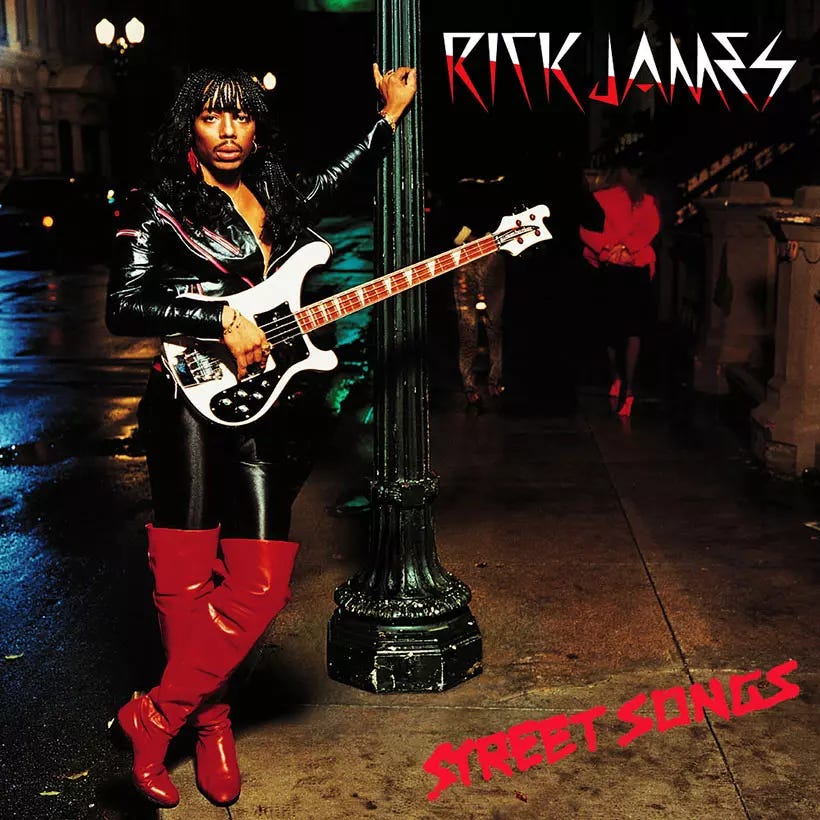
Rick James is standing on a dirty, wet city street. Your eye probably goes first to the thigh-high red vinyl boots, because Rick James was Rick James. But look around him. He’s standing on a street corner with cigarette butts scattered at his feet. Women linger behind him, quite literally walking the street.
And if you’re wondering exactly what everyone is doing out there in the middle of the night, the back cover fills in some of the blanks.
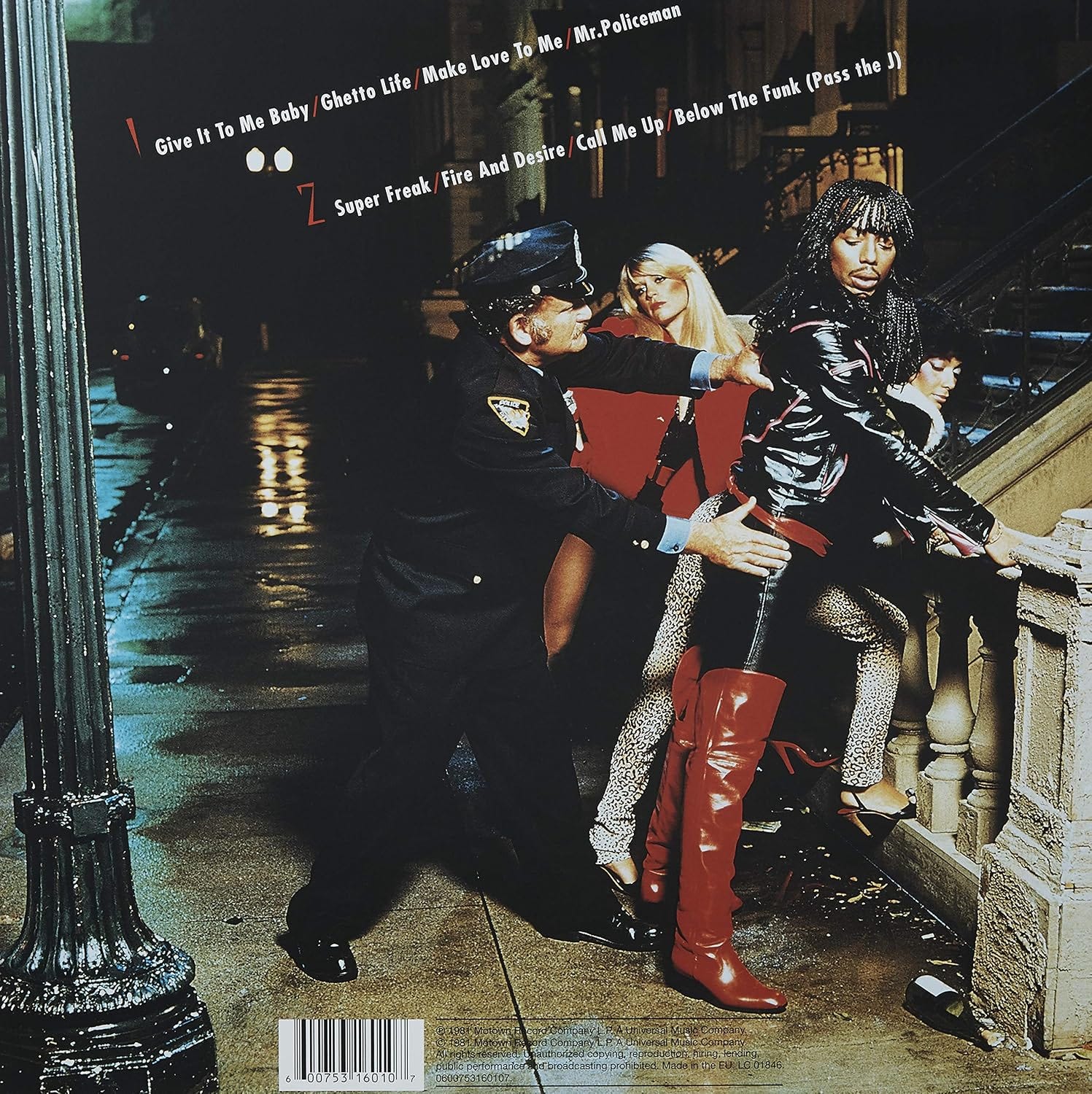
This wasn’t Miami Vice. It wasn’t polished. It wasn’t pastel. It wasn’t Don Johnson stepping out of a Ferrari Testarossa while Jan Hammer played on the soundtrack.
This was closer to the world I was trying to write.
Rick James didn’t just give me something to listen to while I wrote. His music helped me figure out what the fictional music in Midnight Miami should sound like.
The book features funk-rock superstar Petey Maymoore and his 1981 album Heat in the Sheets. Petey isn’t Rick James, but Street Songs provided some of the musical DNA.
Funk. Rock. Sex. Drugs. Street life. And absolutely no interest in subtlety.
Once I could hear that sound in my head, the world became easier to write.
Rick James in 1981
While Rick James might be best remembered today for Dave Chappelle’s imitation, James’ own immortal “Cocaine is a helluva drug,” or the wedding reception standard “Super Freak,” Rick James was much more than a flash in the pan.
When 1981 arrived, he already had a string of three gold albums behind him. But he still hadn’t had the record that pushed him completely over the top.
Street Songs, released April 7, 1981, on Motown’s Gordy label, was that record.
It eventually sold millions of copies and became the defining album of Rick James’ career.
And it starts about as strongly as an album can.
“Give It to Me Baby” / “Ghetto Life”
The album opens with a great one-two punch.
“Give It to Me Baby” is Rick’s lament regarding how his woman does not share his enthusiasm for giving him the business after he comes home drunk and stoned.
On paper, you might empathize with his lady. But after listening to him explain what a great time they’ll have, backed by a driving bassline, keyboards, horns, and guitars, you start to see his point.
The song is full of energy and sets the tone for the rest of the album.
“Give It to Me Baby” gives way to “Ghetto Life,” another high-energy description of the highs and lows of inner-city living, this time drawing on James’ youth in Buffalo, New York.
Sorry, Bills fans. There are no depictions of Rick James smashing through tables.
There is, however, a girl named Nancy who, according to Rick, taught him what he needed to know. If you know what I mean.
Maybe it’s the vibe of the music, but James somehow makes a childhood spent running around with the neighborhood winos sound like it wasn’t such a bad time.
“Make Love to Me” / “Mr. Policeman”
These are the two weakest songs on the album.
In case you didn’t guess, “Make Love to Me” is the album’s first ballad.
And just in case you still can’t figure out what the song is about, Rick is more than happy to walk you through his lovemaking process, step-by-step. If you ever need a sex education refresher course, this is the song for you.
“Mr. Policeman” is a reggae-flavored song in which James calls out police brutality, with Stevie Wonder contributing harmonica.
They can’t all be winners. Fortunately, the next two songs more than make up for it.
“Super Freak” / “Fire and Desire”
“Super Freak” is one of those songs you’ve heard so many times that it’s difficult to appreciate just how good it actually is.
The bassline. The weird keyboard flourishes. The alien accent Rick affects when he sings “She says I’m her all time fave-rhett.”
And wait. Are those the Temptations singing backup? Yes. Yes, they are.
Of course, the lyrics are sensentational.
“She’s a very kinky girl/The kind you don’t take home to mother/She will never let your spirits down/Once you get her off the street.”
What type of woman is this, you might ask? Well, she’s a Super Freak.
Perhaps the best evidence of the song’s greatness is that it somehow became a wedding reception standard.
I enjoy watching Aunt Peggy dance along, perhaps unaware that Rick has moved on to discussing his lady friend’s enthusiasm for expanding the normal number of participants in a romantic encounter.
But what do you expect, that girl’s a Super Freak.
Hey, hey, hey, HEY!
Then comes “Fire and Desire.”
It’s another ballad, this time a duet with Rick James protégé Teena Marie.
A tremendous singer, songwriter, and musician in her own right, Teena Marie was also something of an anomaly at Motown: a white artist whose voice gave absolutely no indication that she was a white artist.
The song starts slowly, with Slick Rick talking to an old lover about how she changed him for the better. Eventually the singing begins, including a long, dramatically pronounced note.
Then Lady T arrives.
She essentially matches James’ vocal structure, except Teena brings what I can only describe as an urban yodel to the proceedings. (Rick’s “Paaaaaiiiiinnnnn” becomes “Paiiinn-heehenheee-nnnn”).
Let me be frank. The song’s bad. Corny, campy, and way over the top. But it’s so bad that it becomes good. In a way.
And before you accuse me of talking out of both sides of my mouth, I should confess something.
Midnight Miami features Gravy’s love interest performing a duet called “Heat in the Sheets” with a remarkably similar vocal structure. It leads into one of my favorite moments in the entire book.
So apparently “Fire and Desire” worked on me more than I would like to admit.
“Call Me Up” / “Below the Funk (Pass the J)”
The album goes out on a high note. No pun intended.
“Call Me Up” is an ode to women calling Rick James for a good time. Unsurprisingly, Rick is not opposed to this scenario.
And while he might now be best known for saying “Cocaine is a helluva drug,” Rick also had a longstanding appreciation for the herbs.
Before Street Songs, his biggest single had been “Mary Jane,” which was not an ode to women’s shoes.
On the album’s final track, “Below the Funk (Pass the J),” James returns to Buffalo in his memories while encouraging everyone to share the joint. It’s a remarkably fast-paced song considering its THC-themed subject matter.
And when Rick is done, he closes the song, and the album, with two simple words:
“Thank you.”
Bonus:
Street Songs
Deluxe Edition
If you’re looking for the album on streaming, I highly recommend the deluxe edition, which includes a 1981 concert recorded in Long Beach, California.
You get to hear the man and the musician at his zenith.
And that distinction becomes important when talking about Rick James.
Because the inevitable descent would come.
#
Rick James never fully recaptured the glory of Street Songs. His subsequent albums sold less, and the closest he came to matching the success of “Super Freak” was when he wrote and produced Eddie Murphy’s #2 hit “Party All The Time” in 1985. But eventually the drugs overwhelmed the music.
I prefer to remember Rick James in 1981, at the height of his powers. Before the arrests and the punchlines. When he was a supremely talented musician who had finally made the album that pushed him over the top.
And I write this with complete sincerity:
Street Songs is a great album.
More than forty years later, it still sounds dirty, funky, funny, dangerous, excessive, and alive.
In other words, exactly what I needed Midnight Miami to sound like.
Give it a chance and it might become one of your all-time fave-rhetts.
Hey, hey, hey, HEY!
Midnight Miami, the first book in the Grits & Gravy Mysteries, is available now! Purchase today at Amazon, Barnes & Noble, or anywhere you like to buy books.